
The Hidden Mortgage Trap: How Amortisation and Tax Erode the Average Australian’s Wealth
If you believe that simply making your standard monthly mortgage repayments is enough to secure your financial future, you are falling victim to a silent, compounding wealth killer. The traditional Australian dream dictates that you buy a home, sign up for a 30-year bank loan, and work a standard job to slowly pay it off.
What the banks and the mainstream media do not tell you is that the system is structurally rigged against your speed of recovery.
When you look at the raw financial physics of traditional lending, the standard path is designed to keep you trapped on a financial treadmill. For the average wage earner, a staggering three-quarters of their total lifetime income is swallowed by just two entities: the taxman and the banks.
At TWP Club, we serve as your Financial Concierge, connecting you with independent specialists who look beyond standard bank products to build aggressive, high-efficiency wealth models. To break free from the cycle of trading time for money, you must understand how mortgages actually work, exploit the legal tax frameworks available to owner-occupiers, and shift your focus from grinding down debt to expanding your asset base.
Let’s expose the mechanics of the amortisation trap and look at how the latest statutory updates to capital gains and negative gearing have rewritten the rules of wealth creation in Australia.
The 7-to-10-Year Invisible Treadmill: Demystifying Amortisation
The single greatest misconception held by everyday property buyers is that every mortgage repayment they make builds significant equity in their home. This is a mathematical illusion caused by the structure of standard bank amortisation schedules.
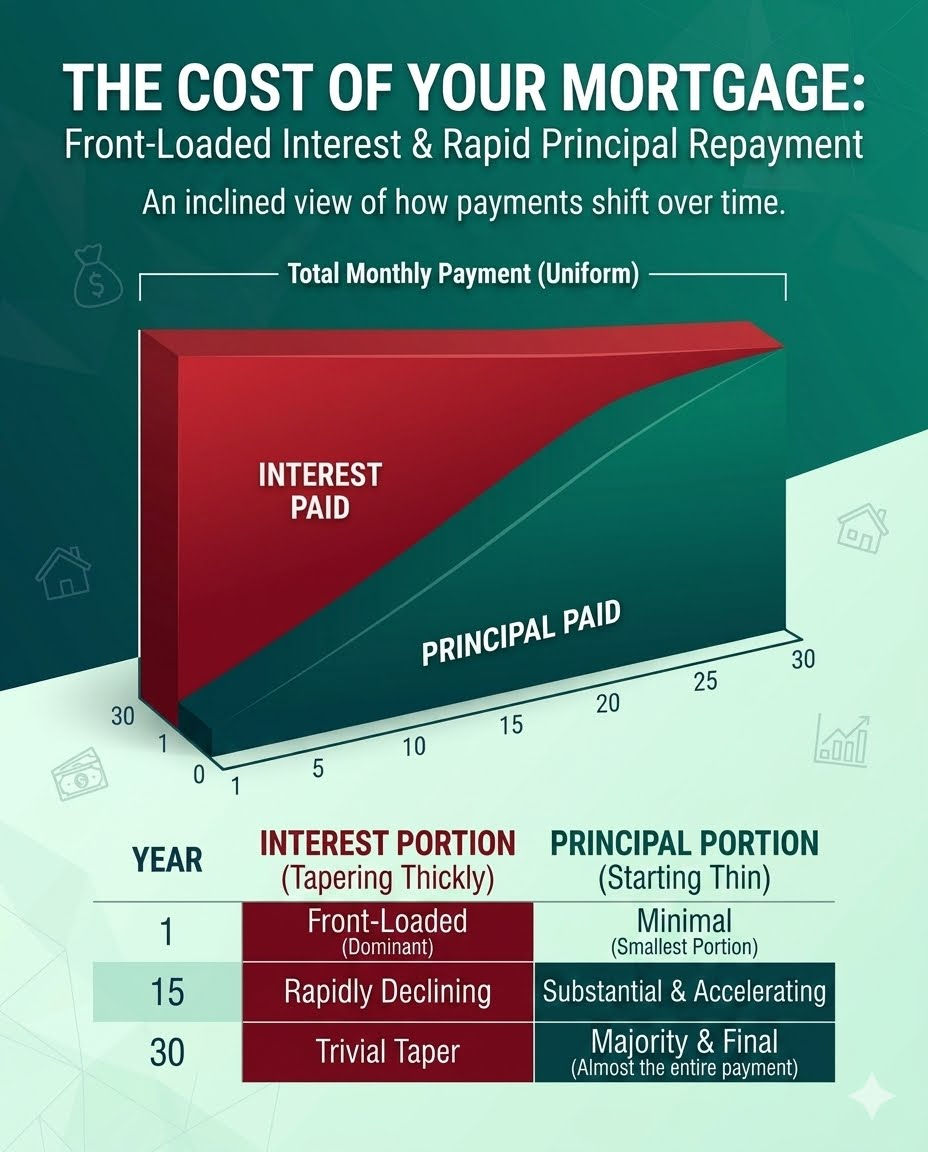
When you take out a principal and interest loan, the bank heavily front-loads their interest charges.
In the first 7 to 10 years of a 30-year mortgage, very little debt reduction actually occurs. Your initial payments are almost entirely consumed by the cumulative effect of interest, leaving the core principal balance virtually untouched. You are effectively renting the property from the bank while carrying all the risks of ownership.
The trap tightens when lifestyle changes occur. The average Australian moves home, upgrades, or refinances their mortgage every five to seven years.
Every time you refinance or switch lenders without an expert debt-reduction strategy, the bank resets your 30-year clock right back to year one.
You are cast right back into the front-loaded interest phase of the schedule, ensuring you remain an enduring cash-flow asset for the banking system while your personal net worth remains stagnant.
The 75% Tax and Bank Squeeze
This structural interest drag does not happen in a vacuum. It collides head-on with your individual tax obligations. In Australia, your primary home loan is classed as non-deductible debt—colloquially known as "bad debt." This means every single dollar you send to the bank to service your home mortgage must be earned in the highest tier of your personal marginal tax bracket first.
Consider the reality for a hard-working professional:
The Income Tax Levy: Your salary is heavily taxed at source by the ATO before you ever touch a single cent.
The Post-Tax Bank Squeeze: The remaining net income is immediately funnelled into paying down the front-loaded interest on your non-deductible home loan.
The Cost-of-Living Residual: The tiny sliver of income left over is what you are expected to live on, invest with, and use to build a legacy.
When you add up the lifetime income tax paid and the cumulative interest pocketed by the banks under standard amortisation schedules, the average Australian surrenders roughly 75% of their working life to these institutions. Trading your limited time for money to service this inefficient loop is a statistical losing game.
Redefining Leverage: Good Debt vs. Bad Debt in the New Era
To escape the 75% squeeze, you must change how you categorise financial liabilities. Debt is not inherently evil; it is merely an energy source. The difference lies strictly in its tax treatment and productivity:
Bad Debt: Loans attached to non-deductible, personal items—like your family home, credit cards, or a car. This debt costs you money, offers zero tax relief, and keeps you tethered to a desk.
Good Debt: Borrowings used to acquire income-producing, appreciating assets—such as strategic investment properties. The interest on this debt is structurally designed to be tax-deductible against your income.
Navigating good debt has become significantly more complex due to sweeping legislative overhauls. As of today’s date, the Australian Government has passed historic legislation that dramatically changes the real estate tax landscape.
Under the new Treasury Laws Amendment framework, negative gearing for residential investments has been strictly restricted to new builds. Furthermore, the traditional 50% Capital Gains Tax (CGT) discount for individuals and trusts has been abolished, replaced by a stricter cost-base indexation model and a minimum 30% tax rate on capital gains.
These massive policy shifts mean that old, lazy investment strategies will now leave you exposed to devastating tax penalties. If you do not have the right structures and specialists guiding your loan portfolio, your "good debt" can quickly turn into a financial nightmare.
Weaponising Investments to Destroy Bad Debt: The Asset Sacrifice Strategy
If you rely solely on your post-tax employment income to grind down your non-deductible home loan, you are playing a losing game against time. Real wealth acceleration occurs when you stop trading your limited time for money and instead use compounding assets to obliterate your liabilities.
This is known as the Asset Sacrifice Strategy. Instead of pouring every spare dollar of your disposable income into a front-loaded mortgage amortisation schedule, you redirect that surplus capital into highly strategic growth assets.
Here is how the wealth engine works:
The Growth Phase: You utilise targeted leverage to secure high-performing investment properties in under-supplied markets.
The Compounding Effect: As these investments grow over a compressed seven-to-ten-year window, their asset value scales at a rate that outpaces traditional wage growth.
The Debt Liquidation: At the optimal cyclical peak, you strategically liquidate a portion of your investment portfolio. The accumulated capital gains are then harvested and deployed as a single, massive lump sum directly against your owner-occupied home loan principal.
By sacrificing a grown asset to extinguish your bad debt, you compress a traditional thirty-year mortgage timeline down to a fraction of the time. You are no longer grinding through a lifetime of work to satisfy a bank; you are letting the property market pay off your home for you.
The Re-Borrowing Loop: Recycling Your Capital Tax-Effectively
Paying off your owner-occupied home is not the end of your financial journey; it is the ultimate starting gun. The moment your non-deductible bad debt hits zero, you unlock an unprecedented level of structural freedom. However, leaving your home completely debt-free with lazy equity sitting dormant inside the walls is a major missed opportunity for wealth retention.
Once the principal home loan is entirely repaid, there is absolutely nothing stopping you from re-borrowing against that clean title. The critical shift is how you re-borrow.
By utilizing a specialist debt-recycling structure, you draw out the newly minted equity to purchase income-producing assets. Because the new loan splits are used strictly for investment purposes, the interest charges immediately transform from non-deductible bad debt into fully deductible good debt. You have effectively replaced an inefficient, post-tax liability with a streamlined, tax-effective wealth generator, using the exact same asset base.
The Ultimate Tax Shelter: The Owner-Occupied CGT Concession
Amidst the sweeping statutory overhauls passed by Parliament, one critical monument remains entirely untouched: the Main Residence Capital Gains Tax Exemption. [1]
With the recent abolition of the traditional 50% CGT discount on standard individual investments and the introduction of a strict 30% minimum capital gains tax rate on established holdings, the financial landscape has fundamentally shifted. Finding a tax-free vehicle in Australia is now incredibly rare.
This makes your primary place of residence the most powerful, legally protected tax shelter left in the nation. Any capital growth manufactured within your owner-occupied
home remains 100% tax-free upon sale.
By focusing your initial debt-reduction energy on the family home, you are building equity inside the single most tax-effective vehicle available under Australian law. You can continuously upgrade, renovate, or downsize your primary residence over a lifetime, accumulating millions of dollars in pure net worth without ever surrendering a single cent of those gains to the ATO.
Stop Trading Time for Money: Partner with TWP Club
The Australian financial system is highly dynamic. The combination of front-loaded bank amortisation schedules, heavy income tax brackets, and the newest restrictions on negative gearing means that standard financial advice is no longer fit for purpose. If you continue to follow the old playbook, you will remain trapped in the 75% bank and tax squeeze forever.
You do not have to settle for a thirty-year financial sentence.
TWP Club acts as your Financial Concierge. We provide you with the critical economic updates you need and introduce you directly to the vetted, independent specialists—from debt-recycling mortgage brokers to master tax structures—required to dismantle your liabilities.
Stop letting your hard-earned income dissolve into structural interest and outdated tax traps. Take control of your balance sheet, optimise your home equity, and let our elite professional network build your path to genuine financial freedom.


Comments